RFID Transforms Automotive Seat Production with Transparent & Intelligent Management
As the automotive industry upgrades towards flexible and intelligent manufacturing, seat production is shifting from traditional "large-batch, single-model production" to "small-batch, multi-model, mixed-line production." This is especially true given the rapid iteration of new energy vehicles and the increasing differences in configurations, which places higher demands on production process management. A single car seat involves multiple processes, including frame assembly, foam assembly, cover sewing, electric module installation, functional testing, and final assembly. Traditional methods relying on paper work orders, manual recording, and barcode scanning are increasingly revealing problems such as low efficiency, error-proneness, and data lag in the context of increased production speed and mixed-line production.
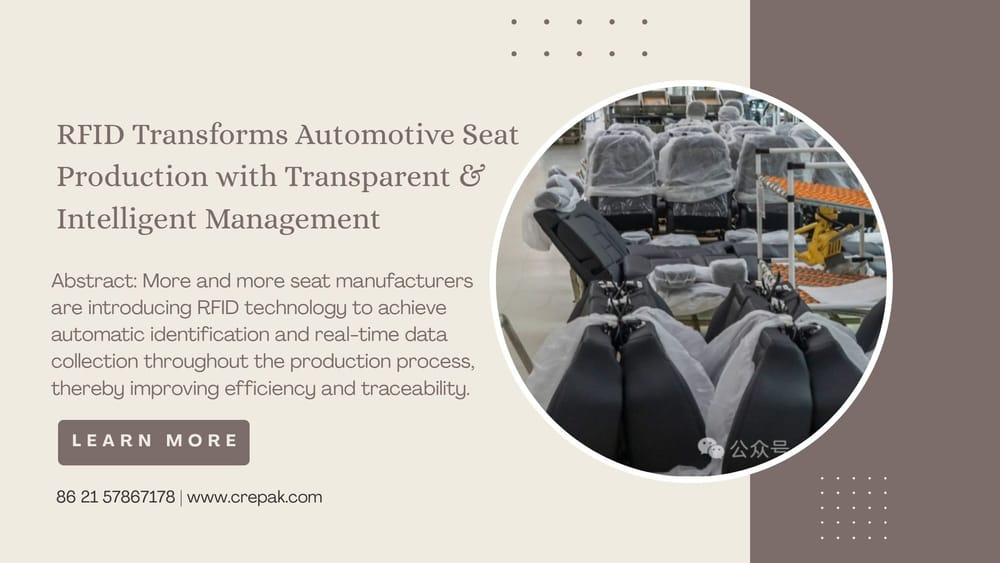
For example, in multi-model mixed-line production, workers need to frequently confirm model and process requirements, which can easily lead to assembly errors, omissions, or mixing. Managers also find it difficult to keep track of the real-time status and progress of each seat, resulting in insufficient process transparency. To address this, more and more seat manufacturers are introducing RFID technology to achieve automatic identification and real-time data collection throughout the production process, thereby improving efficiency and traceability.
Solution
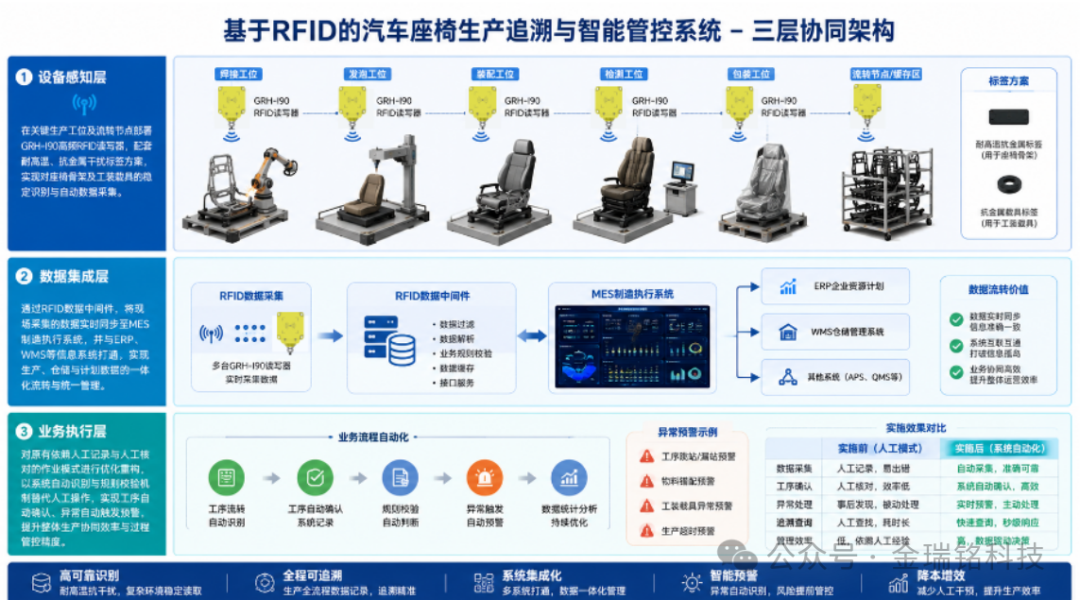
To address the pain points in production management mentioned above, the system adopts a three-tier collaborative architecture to achieve full-process visualization and traceability management from process execution to finished product delivery.
Equipment sensing layer: Deploy GRH-I90 high-frequency RFID readers at key production stations and flow nodes, and use high-temperature resistant RFID Tags and metal interference resistant tag solutions to achieve stable identification and automatic data collection of seat frames and tooling, ensuring high reliability reading capabilities even in complex industrial environments.
Data integration layer: Through RFID data middleware, the data collected on site is synchronized to the MES manufacturing execution system in real time, and integrated with information systems such as ERP and WMS to realize the integrated flow and unified management of production, warehousing and planning data.
Business execution layer : The original work mode that relied on manual recording and manual verification is optimized and restructured. The system's automatic identification and rule verification mechanism replaces manual operation, realizes automatic confirmation of processes and automatic triggering of early warning for abnormalities, thereby improving the overall production collaboration efficiency and process control accuracy.
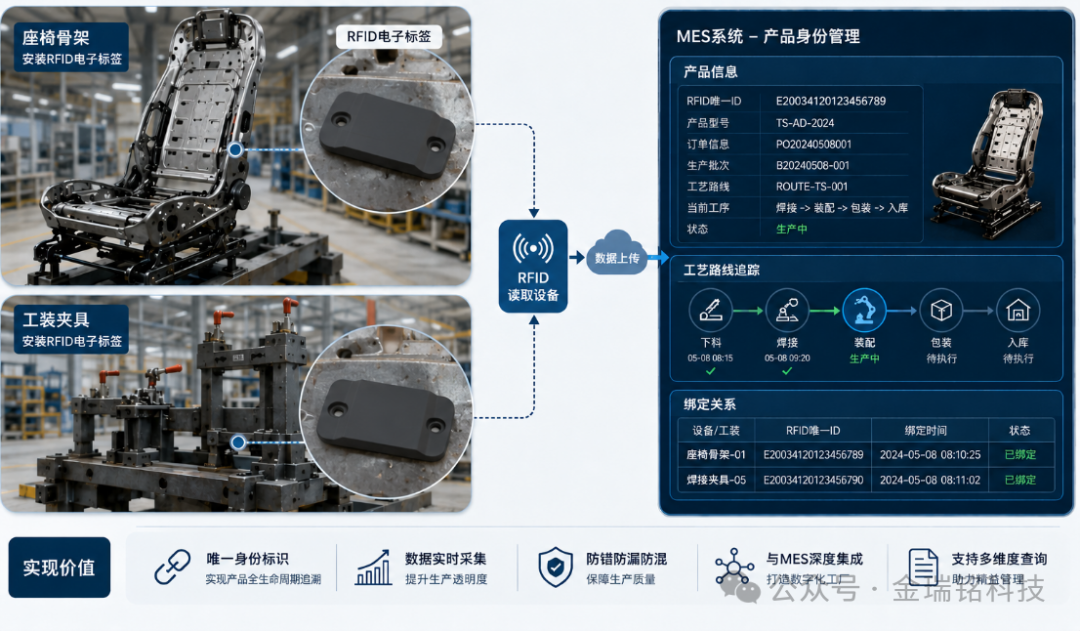
During project implementation, RFID electronic tags are typically installed on the frame or tooling fixtures of automotive seats. Each tag corresponds to a unique ID and is linked to product information in the MES system, forming a complete digital production identity management system that includes key data such as product model, order information, production batch, and process route. Once the seats enter the production line, the system automatically binds the product information and creates a corresponding electronic file, enabling full-process traceability management from the moment the seats are put into operation. Compared to traditional paper work orders, RFID tags do not require manual filling and are not damaged by oil, wear, or frequent handling, making them more suitable for the complex and high-paced production environment of automotive seats.
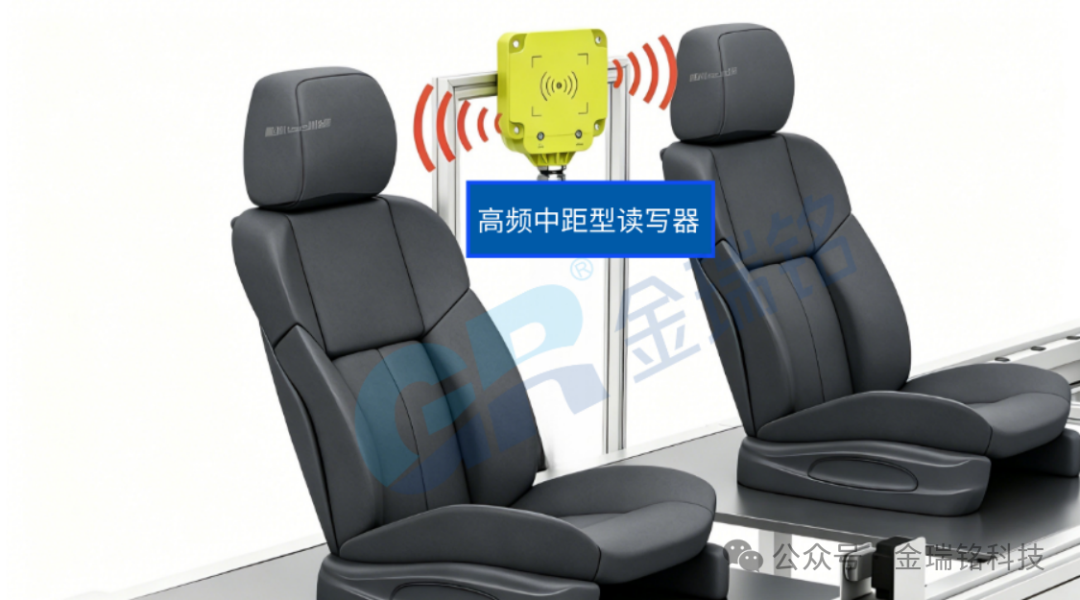
By deploying RFID readers at key workstations on the production line, the system automatically identifies the current product information when a seat moves to its corresponding workstation. It then retrieves process parameters and work instructions from the MES system in real time, including differentiated configurations such as color covers, foam structure, motor configuration, heating or ventilation functions, and airbag modules for different car models. Based on the RFID identification results, the system displays the standard assembly requirements for the current product at the workstation terminal in real time. This eliminates the need for workers to repeatedly check paper work orders or manually query the system, significantly improving work efficiency and information response speed. Simultaneously, it effectively reduces the risk of incorrect, missing, or mixed assembly due to human error, ensuring stable, accurate, and controllable production quality of automotive seats even in multi-model mixed-line production environments.
Hardware product recommendations
The GRH-I90, an industrial-grade high-frequency mid-range reader independently developed by our company, boasts excellent electrostatic and surge protection capabilities and a wide voltage power supply design, enabling it to stably adapt to the complex industrial environment of seat production lines. It supports TCP/IP, serial port, and RS485 communication methods and is compatible with Modbus RTU, Modbus TCP, and our proprietary protocols, allowing for flexible integration with MES systems to achieve real-time production data exchange.
As the automotive industry continues to upgrade towards intelligent manufacturing and flexible production, RFID is becoming a crucial foundational technology for the digital transformation of automotive seat production lines. It not only solves the problems of "low efficiency, error-proneness, and difficulty in traceability" in traditional production, but also helps companies establish a closed-loop data system covering the entire process of production, quality, warehousing, and logistics.